

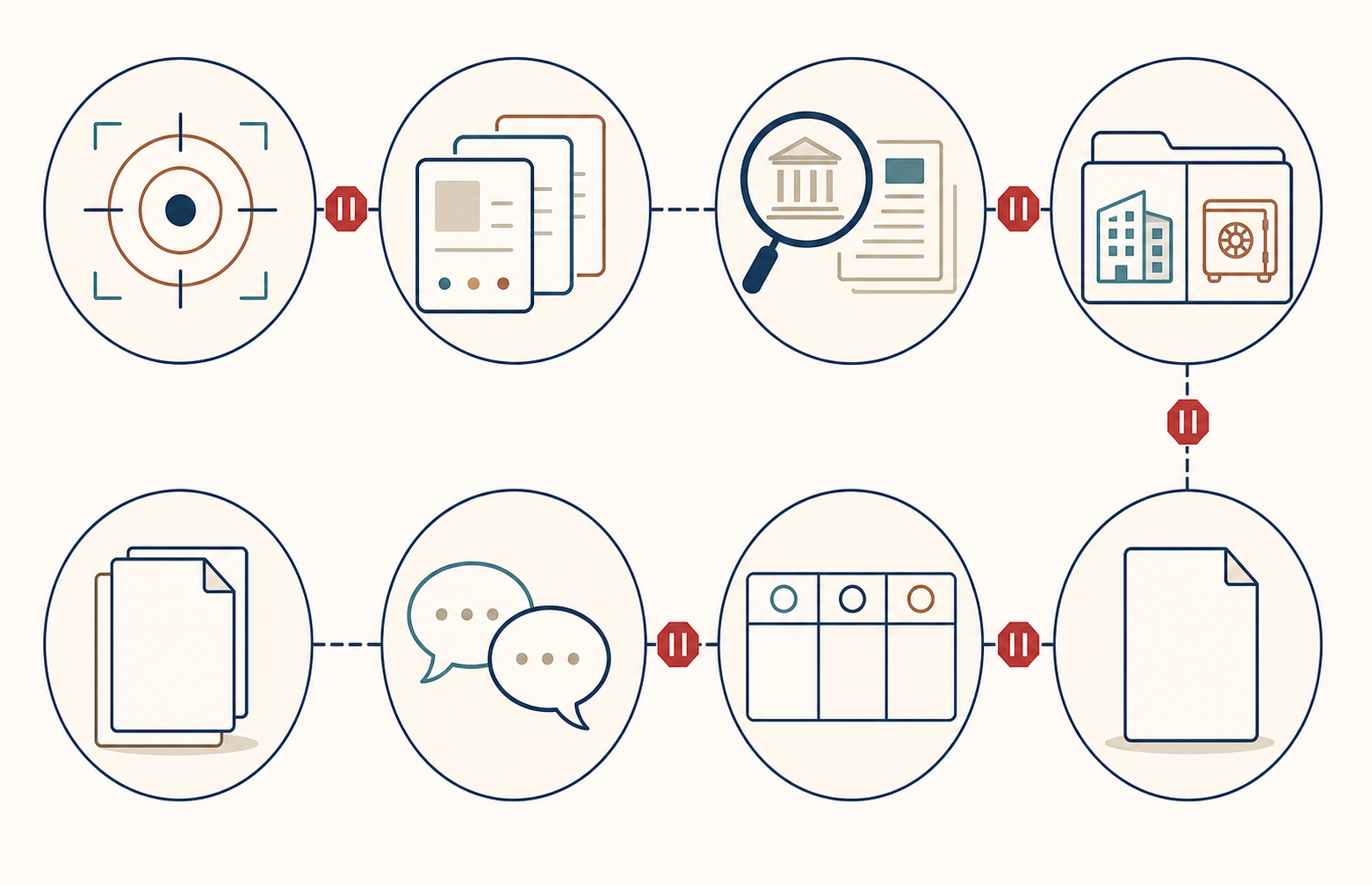
Dubai off-plan due diligence workflow
How to Evaluate Dubai Off-Plan Projects Safely
Short answer: define your objective and limits, build a shortlist, verify each project, developer and escrow detail through current Dubai Land Department records, obtain the complete document pack, use independent UAE-qualified advisers, stress-test every payment obligation, inspect location and progress evidence, and record explicit stop conditions before paying or signing.
Important: this educational workflow is not legal, tax, mortgage, immigration or financial advice and does not recommend any project. DLD records, registration or escrow information do not guarantee completion, quality, liquidity, suitability or returns. Use current official records and independent professional advice for the actual transaction.

Step one defines the decision before viewing projects
Write a one-page buyer brief before opening listings. State whether the property is intended for personal use, long-term holding or another lawful purpose. Record the desired handover window, preferred property type, location constraints, accessibility needs, expected occupancy and how much uncertainty you can accept. Avoid turning a sales claim about appreciation or rent into your objective.
Build financial boundaries with qualified advisers. List the maximum initial commitment, scheduled instalments, closing and registration-related amounts, furnishing or fit-out needs, possible finance costs, ongoing service charges and a contingency reserve. The actual obligations depend on the project, contract, buyer, financing and current rules. This guide does not calculate them or say what you can afford.
International buyers should separately identify currency-conversion, transfer, banking, tax, residency and estate-planning questions. Do not assume a property creates visa eligibility or a guaranteed immigration outcome. Write those questions for UAE-qualified legal, tax, financial and immigration advisers as applicable. The brief is complete when it contains objectives, constraints, decision criteria and professional questions—not when it selects a development.
Step two builds a shortlist without treating listings as evidence
A brokerage directory can help discover names and locations. Inteva publishes a project directory and a Dubai projects page. Treat these as discovery sources only. A page may change, age or omit transaction-specific terms. It does not replace the current DLD record, developer documents or independent review.
Record each candidate in the same table: exact project name, project number if available, developer’s legal name, location, unit identifier, quoted price and date, payment schedule, expected completion statement, source URL and contact who supplied it. Label anything unverified. Do not merge similarly named developments, marketing entities or phases.
Reduce the shortlist using the buyer brief rather than promotional language. A project that does not fit the intended use, payment capacity, timing or location should be removed before deeper review. Do not rank by an advertised yield, “limited availability,” awards, influencer content or a countdown. Preserve screenshots and dates as evidence of what was represented, but confirm material facts at source.
Step three checks the project, developer and escrow through DLD
Use the official DLD Project Status Enquiry. DLD says customers can search by land number, project number or project name and view project completion and details. Search the exact candidate and save a dated record of what you find. If you cannot confidently match the marketed project to the official record, pause.
The live project-status interface exposes fields for project, developer, inspection and escrow information. Compare legal names, project number, status, location, developer and escrow details with the marketing material and proposed documents. Ask for an explanation and independent verification when anything conflicts.
DLD’s project registration service describes the developer-side process to register a real estate project and open an escrow account for off-plan sales. DLD’s FAQ also explains project escrow and directs users to official project tracking. These checks are essential but not a performance guarantee. Registration and an escrow record do not prove future completion, construction quality, resale demand or a return.
| Verification field | Compare against | Stop when |
|---|---|---|
| Project identity | Exact name, number, phase and location | The marketed unit cannot be tied to the official project |
| Developer identity | Legal name in DLD and contract pack | Names conflict or an intermediary cannot explain its role |
| Project status | Current DLD status and dated progress evidence | Claims rely only on old screenshots or marketing |
| Escrow details | DLD record and payment instructions | Funds are requested to an unexplained or mismatched account |
| Unit details | Reservation, plan, schedule and draft contract | Unit, size, price or schedule differs across documents |
Step four collects the complete transaction pack
Request the documents before paying a material amount or signing. The exact pack varies, so ask an independent UAE-qualified lawyer what is required. Common review items may include the reservation form, draft sale and purchase agreement, unit plan and specifications, payment schedule, completion and handover provisions, delay and termination clauses, assignment or resale rules, service-charge information, disclosures, payment instructions and all fee schedules.
Make a document register with filename, version, date received, issuing party and unresolved questions. Confirm that project, developer, buyer and unit names match across records. Separate signed contractual terms from brochures, messages and verbal promises. If a salesperson makes a material representation about views, finishes, amenities, timing, rental programmes, fees or exit rights, ask where it appears in the transaction documents and have counsel review it.
Do not sign a blank, incomplete or inconsistent document. Do not rely on a translation you cannot assess; obtain qualified language and legal support. Ask who holds each payment, what reference must be used, when it becomes refundable or non-refundable, and which written provision governs. Independently verify payment instructions using trusted contact details, particularly after any last-minute bank-account change.
Step five separates the sales relationship from independent advice
A broker can explain listings and facilitate a transaction, but the buyer should understand the broker’s role, remuneration and relationship with the seller or developer. Inteva’s about page describes its general real-estate positioning. Do not infer a relationship with a particular developer or project from this article. Ask for the parties and commercial relationships relevant to the actual unit in writing.
Use a UAE-qualified lawyer who acts for your interests to review documents, title and transaction mechanics. Use appropriately qualified tax, financial, mortgage and immigration advisers for those separate questions. An adviser in one discipline should not be assumed qualified in another. Confirm credentials, engagement scope, fees and conflicts.
Give advisers the same evidence file rather than a marketing summary. Ask counsel to explain payment default, developer delay, cancellation, assignment, dispute, handover, snagging, changes to plans and any jurisdiction or arbitration provisions. Ask finance and tax advisers to model your actual circumstances. The correct outcome can be to pause or decline.
Step six stress-tests cash flow and exit assumptions
Create a dated schedule of every expected payment from reservation through handover and post-handover obligations. Include currency conversion, transfer costs, finance conditions, taxes or fees identified by advisers, service charges, furnishing and a contingency. Do not use an advertised monthly figure when instalments vary.
Run at least three non-predictive scenarios: the plan proceeds on the stated schedule; handover or financing timing changes; and an exit or assignment is unavailable when wanted. For each, ask whether the buyer can meet obligations without relying on an unverified sale, rent, refinance or currency movement. This is a resilience exercise, not a return forecast.
Never treat projected rent, appreciation, yield or resale demand as guaranteed. Request the assumptions and data behind any projection and have them independently assessed. Consider transaction costs and restrictions before assuming an early exit is possible. If the purchase works only under an optimistic forecast, record that as a stop condition.
Step seven inspects location and progress evidence
Visit the area when possible and evaluate travel, access, surrounding construction, services, noise, orientation and the difference between a show unit and the contracted unit. A model apartment illustrates design; it does not prove the final unit’s exact view, dimensions, finishes or completion date. Compare every material point with the signed specification.
Use current DLD inspection and status information, plus dated evidence supplied through the official project or developer channels. Ask how progress updates are produced and whether the specific phase is covered. Do not substitute social-media footage for official records. If buying remotely, use independent representatives and documented verification rather than a salesperson’s live video alone.
Step eight writes a decision memo before commitment
- Restate the intended use and non-negotiable constraints.
- List the exact project, developer, unit and official identifiers.
- Attach the current DLD project, developer, status and escrow checks.
- Summarise counsel’s document findings and unresolved issues.
- Show the full payment schedule and stress scenarios.
- Record broker, developer, adviser and payment relationships.
- List every assumption that remains unverified.
- Choose proceed, pause, renegotiate or decline, with reasons and an expiry date for the evidence.
A decision memo slows the process enough to reveal gaps. Repeat key checks immediately before payment or signing because records, availability, terms and instructions can change.
Common mistakes and clear stop signs
- Paying because a unit is described as the last one or a price expires quickly.
- Failing to match the exact project, phase, developer and unit across DLD and documents.
- Sending funds to an account that does not reconcile with independently verified instructions.
- Relying on brochures, messages or verbal promises instead of reviewed contractual terms.
- Assuming registration or escrow guarantees completion, quality, resale or returns.
- Using projected rent, appreciation or visa eligibility as a certainty.
- Accepting legal, tax, mortgage or immigration advice from someone without verified scope and qualifications.
- Signing incomplete documents or using an unverified translation.
- Proceeding when the payment plan works only if an optimistic exit or financing event occurs.
Frequently asked questions
Does DLD project registration make an off-plan purchase safe?
It is an essential verification point, not a guarantee. Buyers still need current records, contract review, payment verification, scenario testing and independent advice.
Can a broker perform all due diligence for the buyer?
A broker can provide information and facilitate the process, but independent legal, financial, tax, mortgage or immigration advice should come from appropriately qualified advisers acting within a clear scope.
Does this guide identify the best Dubai off-plan project?
No. It recommends no development, developer, area, price or return. It provides a repeatable verification workflow.
Is a projected rental yield enough to compare projects?
No. A projection is assumption-dependent and not guaranteed. Review its data and costs, then test whether the decision remains viable without the projected outcome.
Request a documented next-step conversation
Use Inteva’s contact page to request exact project and unit identifiers, current documents, payment schedule and the role of each party. Then verify the project through DLD and take the complete pack to independent UAE-qualified advisers before paying or signing. This draft requires legal, financial and editorial review before publication.




Join The Discussion