

Risk-aware property planning for Abu Dhabi buyers
Plan Due Diligence for Abu Dhabi Off-Plan Projects
Short answer. Before committing to an Abu Dhabi off-plan project, verify the project and relevant parties through current official channels, obtain the complete proposed transaction documents, confirm the approved payment route, and have an independent UAE legal professional review your obligations. Then stress-test the full payment schedule, delay scenarios, exit restrictions and handover process. A brochure, portal listing or verbal promise is not a substitute for those checks.

A sound off-plan decision starts with official verification, independent document review and a realistic payment and handover plan.
Define what an Abu Dhabi off-plan purchase must achieve
Off-plan property is bought before the finished unit is available for ordinary inspection and occupation. That changes the buyer’s task. You are evaluating not only a future home or investment, but also a development process, a document package, scheduled obligations and the consequences if circumstances change.
Write a one-page buyer brief before viewing projects. Record intended use, preferred area, minimum practical space, target handover window, cash available at each payment stage, financing assumptions, currency exposure, ongoing ownership costs and the maximum disruption you could absorb. If the purchase depends on a particular return, resale date, mortgage approval or residency outcome, label that dependency instead of treating it as certain.
Separate requirements from preferences. A necessary handover window, accessibility need or maximum scheduled commitment should not be traded away for an attractive rendering. Inteva Real Estate maintains an Abu Dhabi projects route for starting a discussion, but current inventory, pricing and terms must be confirmed directly for each proposed transaction.
Verify the project and relevant parties through official sources
The Abu Dhabi Real Estate Centre describes stages that include project registration, licensing for marketing and sale, an escrow process and registered sale-and-purchase documentation in its project-development journey. Use the current official route as the starting point for checks; do not assume a marketing page proves that every required stage applies or is complete.
Ask for the exact legal project name, developer identity, property or unit reference, marketing-permit details, broker or representative identity, and the documents needed to confirm authority. Compare names and identifiers across the reservation form, payment instructions, proposed sale-and-purchase agreement and official records. If the document type is supported, use ADREC’s document-verification service. Check the current rules and regulations or obtain professional advice when a requirement is unclear.
A missing record, inconsistent name or pressure to pay before verification is resolved is a stop signal, not an invitation to guess. Ask the relevant authority or an independent UAE legal professional how the current rules apply to the exact transaction.
Review the complete proposed document set independently
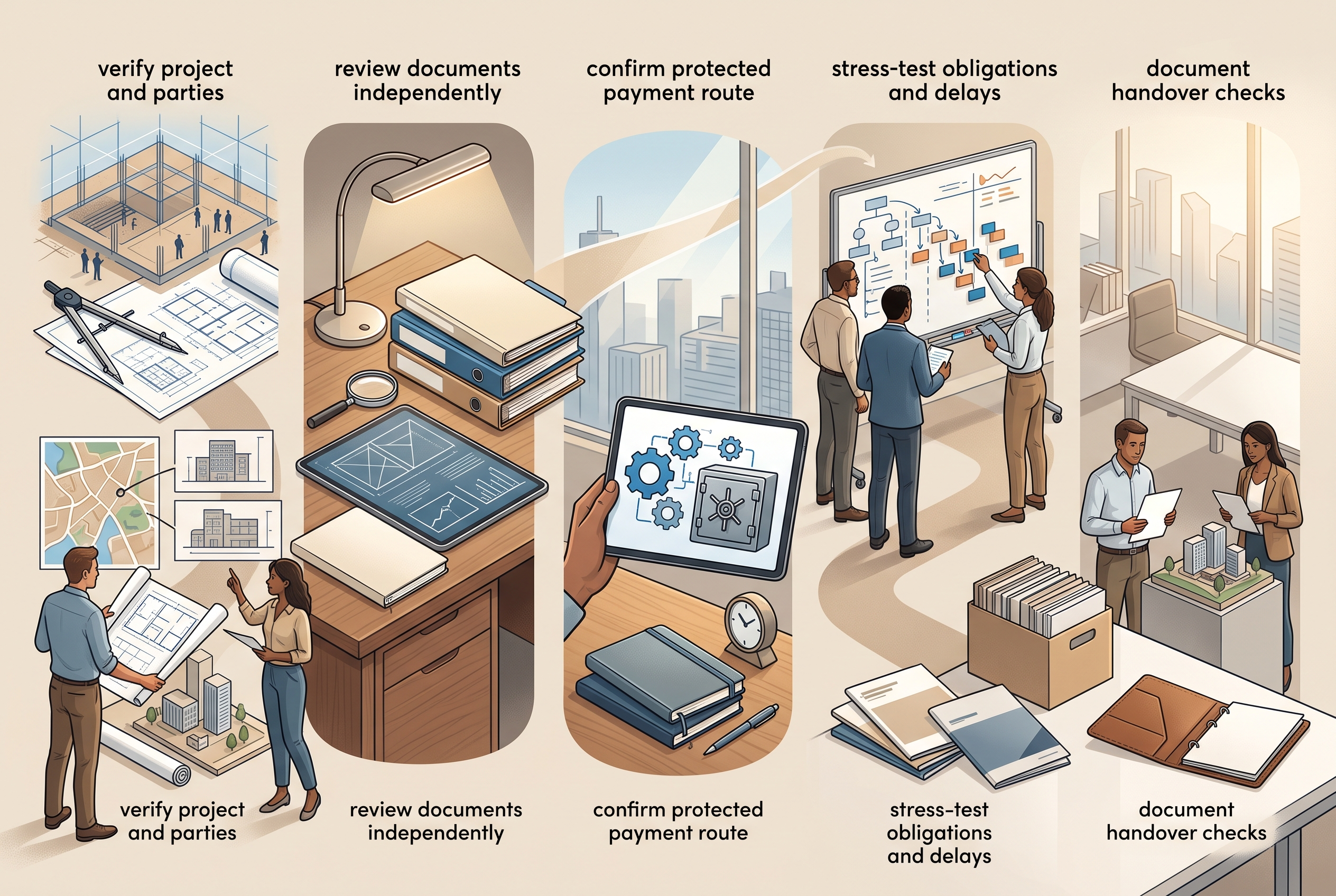
Complete each verification and review stage before making the next binding commitment.
Request the documents you would be expected to sign or accept before paying a reservation amount. The exact set varies, but the review should identify the unit, specifications, payment schedule, completion and handover provisions, change rights, delay provisions, buyer default consequences, cancellation process, transfer or assignment restrictions, fees, dispute route and any document incorporated by reference.
Give the complete set to an independent UAE legal professional. Ask for a plain-language explanation of what the documents require from you and what happens when an assumption fails. Marketing summaries may be useful orientation, but the binding language and official record deserve priority.
| Decision area | Evidence to request | Question to resolve |
|---|---|---|
| Identity and authority | Official project, developer, broker and permit details | Do the names and identifiers match throughout? |
| Unit and specification | Unit reference, plan, schedule of finishes and change provisions | What exactly is promised, and what may change? |
| Payment | Written schedule and verified payment instructions | Where is each payment made, and what proof is retained? |
| Delay and default | Contract clauses and notice process | What rights, obligations and time limits apply? |
| Exit and transfer | Assignment, resale and cancellation terms | Is transfer allowed, under what conditions and at what cost? |
| Handover | Inspection, completion, registration and outstanding-payment process | What must happen before acceptance? |
Model the total commitment instead of one advertised number
Build a dated cash-flow table from reservation through handover and early ownership. Include every amount identified in the current documents and obtain advice on registration, administration, financing, tax, currency transfer, insurance, service charges and other costs that may apply. Do not invent a percentage from a generic article or assume today’s rule will remain unchanged.
For each payment, record the due trigger, source of funds, currency, evidence required and fallback if financing or funds transfer is delayed. Stress-test higher borrowing costs, currency movement, a later handover and an overlap with existing rent or mortgage payments. If the purchase only works under one optimistic path, the risk is visible before signature.
This is planning, not financial advice. Always consult with a financial advisor familiar with the UAE property market to ensure your investment aligns with your financial goals.
Plan for delay, change and exit risk
Off-plan projects can face various risks, including construction delays, changes in market conditions, or alterations in project specifications. Understanding these risks is crucial for informed decision-making. Consider factors such as the developer’s reputation, historical project completion rates, and market trends in Abu Dhabi.
For instance, a report by Property Finder indicates that off-plan property prices in Abu Dhabi have fluctuated by up to 15% in recent years, highlighting the importance of thorough due diligence.
Prepare for handover before reserving
Understanding the handover process is essential. Ensure you know the timeline for completion, the inspection process, and what documentation will be required at handover. This preparation can prevent last-minute surprises and ensure a smooth transition into your new property.
Common off-plan mistakes
Many buyers make mistakes when purchasing off-plan properties, such as failing to verify the developer’s credentials, not understanding the payment schedule, or neglecting to consider the long-term implications of their investment. Educating yourself on these common pitfalls can help you avoid costly errors.
Frequently asked questions
Here are some common questions buyers have about off-plan properties in Abu Dhabi:
- What is an off-plan property? An off-plan property is one that is purchased before it is completed, often based on architectural plans and marketing materials.
- What should I look for in a developer? Check their track record, reputation, and previous projects to gauge their reliability.
- How can I ensure my investment is secure? Conduct thorough due diligence, including legal reviews and financial assessments.
Speak with Inteva Real Estate
If you’re considering an off-plan property in Abu Dhabi, contact Inteva Real Estate for expert guidance and personalized service. Our team is dedicated to helping you make informed decisions in the UAE’s dynamic property market.
Key Takeaways
- Conduct thorough due diligence before committing to any off-plan project in Abu Dhabi.
- Verify all project details and developer credentials through official channels.
- Review all proposed documents with an independent legal professional.
- Model your total financial commitment, considering all potential costs and risks.
- Be aware of common mistakes when purchasing off-plan properties to avoid costly errors.




Join The Discussion