

UAE property buyer guide
How to Buy Property in the UAE With Careful Due Diligence
Short answer: To buy property in the UAE responsibly, define the emirate and intended use, confirm that the property and ownership structure are available to you, verify the broker, developer, project or title through the relevant land authority, and have the contract and complete cost schedule reviewed before paying. Keep every representation in writing and make the final decision from official records, not a listing alone.
UAE property searches often begin with a development image or an advertised payment plan. A sound buying process begins earlier, with eligibility, identity, official records and a written budget. The checks also change between a completed home and an off-plan purchase, and between emirates. This guide is a due-diligence workflow rather than a list of promoted projects, predicted returns or time-sensitive inventory.

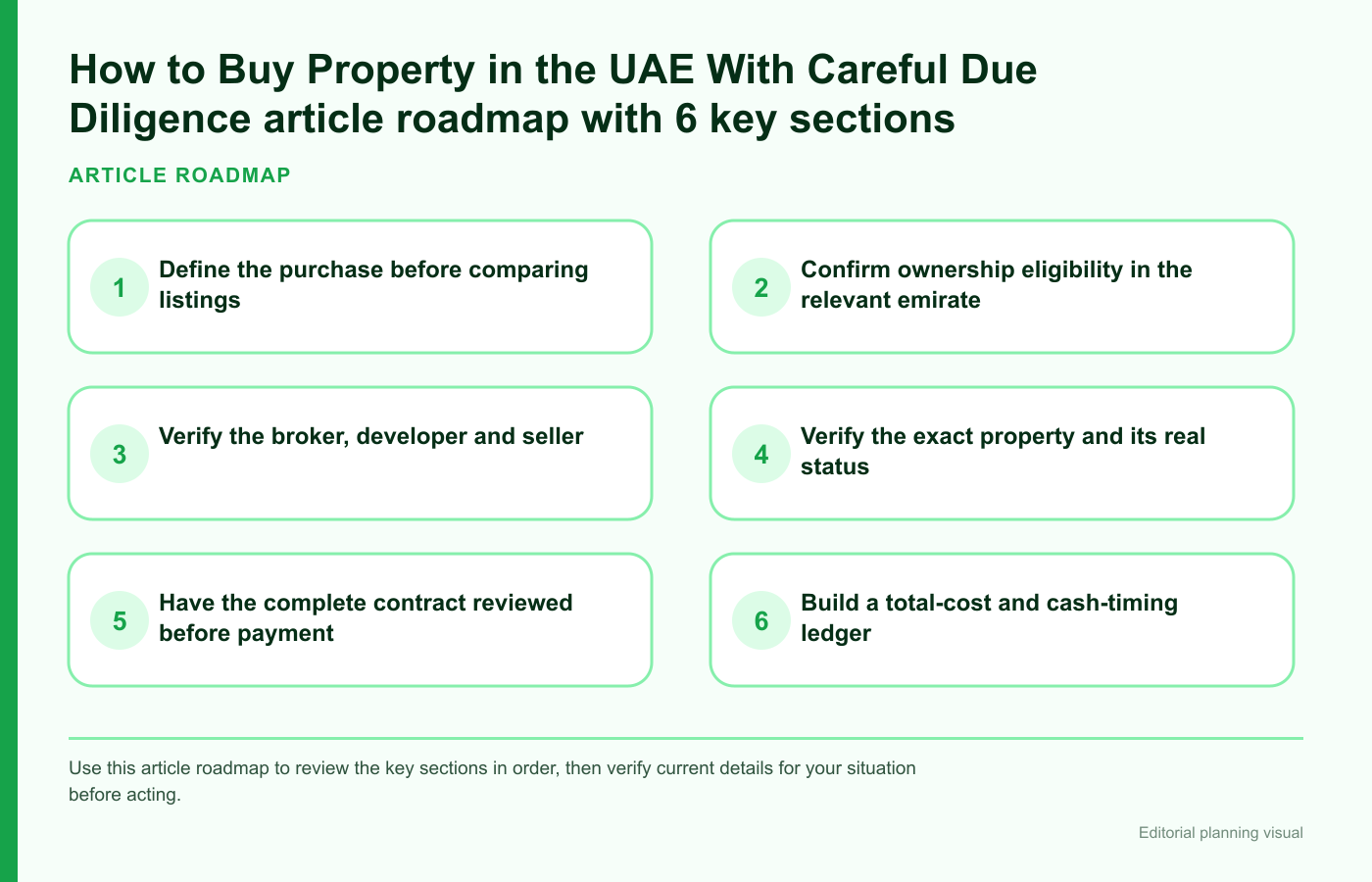
Define the purchase before comparing listings
Write down the intended use, preferred emirate, target neighbourhood, holding period and non-negotiable features. A home for personal occupancy has a different decision path from a unit selected primarily for rental income. If financing is involved, obtain a realistic borrowing view before treating a price band as affordable. If the money will cross currencies, add a buffer for exchange-rate movement rather than assuming today’s conversion will hold until completion.
Decide whether you are considering completed property, off-plan property or both. A completed unit lets you inspect the physical asset and review an existing building, but it still requires title, seller and liability checks. An off-plan purchase shifts more attention to the developer, registered project, escrow arrangements, construction status, contract milestones and handover definitions. Do not let a lower initial instalment blur the total commitment.
Inteva Real Estate publishes separate routes for Dubai projects, Abu Dhabi projects and Sharjah projects. Treat those routes as starting points for questions. Current availability, price, developer terms and legal eligibility still require property-level verification.
Confirm ownership eligibility in the relevant emirate
The UAE Government’s official information on expatriates buying property explains that property rules are set at emirate level and that foreign ownership is connected to designated areas and applicable local law. That means a broad statement about “buying in the UAE” is not enough. Confirm the exact parcel, ownership right and buyer status with the competent authority and qualified legal adviser.
Ask what interest is being transferred, whether the buyer category is eligible, and which authority will register the transaction. If the purchase is connected to a residence or visa objective, verify that path separately with the responsible government authority. Do not assume that purchasing any property automatically produces a particular immigration outcome.
Stop if the ownership explanation is verbal, if the plot or unit cannot be matched to an official record, or if someone discourages independent advice. Eligibility is a gate, not a detail to solve after paying a reservation amount.
Verify the broker, developer and seller
Record the full legal name of every party, the person authorised to sign, the brokerage or licence details provided, and the account that will receive money. Match those details across the reservation form, contract, invoice and official verification service. Similar trading names and copied logos are not proof of identity.
The Dubai Land Department provides digital services for checking items such as real-estate licences, brokers, developers, projects and title information in Dubai. Use the authority for the emirate where the property sits; do not use a Dubai lookup as proof for another emirate. Save dated results and ask a qualified adviser what each result does and does not establish.
For a resale, verify the seller’s authority, title information and any mortgage or restriction that affects transfer. For off-plan property, verify the developer and project rather than relying only on a sales representative’s identity. Payments should follow the verified contract and authorised process. A request to pay an unrelated individual or an unexplained account is a reason to pause.
Verify the exact property and its real status
A project name is not a unit. Record the plot, building, unit number, floor, stated area, parking, storage and plan revision. Compare the listing, reservation form, contract drawings and official record. Ask how the area is measured and which figure governs price or service charges. If a view, orientation or layout matters, make it a written contractual point rather than an expectation created by marketing imagery.
For completed property, arrange an appropriate inspection and review building condition, access, utilities, common areas, outstanding charges and material defects. For off-plan property, check official registration and current project status, then read how the contract handles specification changes, delays, termination and handover. A construction photograph without a verified date and unit connection is not a status report.
Use Inteva’s broader property project route to create a shortlist, then build an evidence file for each candidate. Separate confirmed records, seller statements and open questions so enthusiasm cannot turn an unanswered point into an assumed fact.
Have the complete contract reviewed before payment
Read the reservation document and the main sale agreement together. Identify the unit, total price, deposit, instalments, completion or transfer conditions, default consequences, cancellation terms, assignment restrictions, included specifications and dispute process. Ask which language version controls and which attachments form part of the agreement.
For an off-plan purchase, focus on milestone definitions, permitted changes, delay provisions, handover notice, defect reporting and what happens if promised finance or resale plans do not materialise. For a completed purchase, focus on transfer conditions, vacant possession where relevant, adjustments, outstanding liabilities and the condition expected at handover.
Independent legal review is not a substitute for official verification, and official verification is not a substitute for reading the contract. Both matter. Do not sign a blank field, rely on a side message that is absent from the agreement, or assume a representative can change the developer’s written terms after a problem occurs.
Build a total-cost and cash-timing ledger
List every known category without guessing a universal percentage: purchase price, registration or transfer charges, brokerage, legal review, valuation, financing costs, insurance where applicable, service charges, utility setup, inspection, furnishing and a contingency. Ask each provider for the current amount, calculation basis, due date, refundability and payee.
Map the payment dates against available funds. An affordable headline price can still create a cash-flow problem if registration, deposit, mortgage fees and furnishing arrive close together. For off-plan schedules, test whether later instalments remain manageable if income, finance or currency assumptions change. Do not classify a developer incentive as a saving until the complete price and obligation are compared.
Investment buyers should model conservative occupancy, operating costs, service charges, management, maintenance and exit costs. An advertised yield is not a personal forecast. Use independent financial and tax advice for your circumstances and jurisdiction.
Plan transfer, inspection and the first months of ownership
Before completion, create a responsibility list covering final inspection, transfer documents, funds, keys, access cards, utilities, community registration, insurance, defect reporting and property management if needed. Confirm who attends, what identification is required and what evidence shows the transfer is complete.
For a new unit, distinguish practical completion, handover notice, title registration and the end of any defect-reporting period. Record issues with dated photographs and submit them through the contractual channel. For a resale, verify agreed inclusions and the condition at the final inspection. Do not release a disputed balance or waive a contractual right without qualified advice.
After transfer, retain the signed agreement, official registration evidence, payment receipts, inspection documents, service-charge information and correspondence. A complete file helps with management, future sale, finance, insurance and any later dispute.
Use one evidence-led scorecard for every candidate
| Decision area | Evidence to collect | Stop condition |
|---|---|---|
| Eligibility | Emirate-specific ownership confirmation for the exact property | Ownership right or buyer eligibility remains unclear |
| Parties | Verified seller, broker, developer and signing authority | Names, licences or payment instructions do not match |
| Property | Official unit or title details, plan and current status | The marketed unit cannot be tied to an official record |
| Contract | Complete agreement, attachments and independent review | Material promises exist only in messages or speech |
| Cost | Written total-cost ledger and payment dates | Major charges or funding gaps remain unknown |
| Exit and use | Realistic occupancy, management and resale assumptions | The decision depends on guaranteed returns or instant resale |
Score evidence quality separately from attractiveness. A desirable location with weak documentation should not outrank a clearly documented alternative simply because its marketing is more polished.
Pause when the transaction creates pressure or ambiguity
- A claim of guaranteed return, guaranteed appreciation or risk-free resale.
- Pressure to pay before official project, title, party or account verification.
- A reservation form that does not identify the precise unit and refund terms.
- Important promises that are missing from the controlling contract.
- Payment instructions that change without a verified formal process.
- Eligibility or visa claims presented as automatic for every property.
- Resistance to independent legal, financial, inspection or valuation advice.
- Marketing images treated as proof of view, size, finish or construction status.
Common mistakes to avoid
- Choosing an emirate or project before defining use, budget and buyer eligibility.
- Treating a listing, brochure or representative message as an official record.
- Comparing deposits while ignoring total price, fees and instalment timing.
- Using a verified broker as a substitute for verifying the seller, developer and property.
- Signing before every attachment, specification and material promise is available.
- Assuming a completed unit and an off-plan unit require the same due-diligence path.
- Building an investment decision around advertised yield or future appreciation.
Frequently asked questions
Can a foreign buyer purchase property anywhere in the UAE?
No single answer applies to every emirate, area, property or buyer. Confirm designated ownership rules and the exact right being transferred with the competent authority and qualified adviser.
How do I verify a Dubai broker or project?
Use the relevant Dubai Land Department verification service and match the result to the legal names and property documents. Ask an adviser to explain the scope of the record.
Is an off-plan payment plan the same as affordability?
No. Map the complete price, charges and every due date against verified funds, financing and currency exposure.
Does property ownership guarantee a UAE visa or return?
Do not assume either outcome. Verify immigration eligibility through the responsible government channel and treat returns as uncertain, property-specific projections.
Take a documented next step
Start with Inteva Real Estate’s UAE buyer guide, then use the contact route to ask about a specific emirate and property. Request the legal identity, official record, complete cost schedule and contract documents needed for independent review before making a payment.
This is general educational information, not legal, financial, tax, immigration or investment advice. Rules, projects, availability, charges and contracts can change; verify the exact transaction with the relevant UAE authority and qualified independent advisers.




Join The Discussion